Storm-Proof Your Home: The Power-Cut Kit Worth Buying Before the Next Named Storm
Contains affiliate links. We only point you at kit that solves a real problem.
What happened
Storm Boelo, the second named storm in a week, swept across the UK over the weekend of 24–25 October 2026. The BBC reported gusts of 85mph at Machrihanish in western Scotland and The Needles off the Isle of Wight, and 84mph at Capel Curig in north Wales. National Grid said more than 124,000 properties had power restored since the start of the storm, with 10,860 still cut off at 06:30 on Sunday. In the North West, SP Electricity North West said more than 57,000 homes had lost power (Radio Royal). It was trending on X all weekend (Storm Boelo on X).
The Met Office has already flagged another yellow wind warning for Tuesday in the north. In other words: this won’t be the last power cut of the winter.
Why it’s trending
Searches for storm and safety kit are climbing. Look Into’s UK Demand Index for the week to 15 October shows carbon monoxide alarm searches up 10.7% week on week, and that was before Boelo arrived. Power cuts, candles, camping stoves and gas heaters being dragged indoors are exactly when CO risk rises.
Here’s the kit that actually matters, in order of priority.
1. A carbon monoxide alarm (or a fresh one)
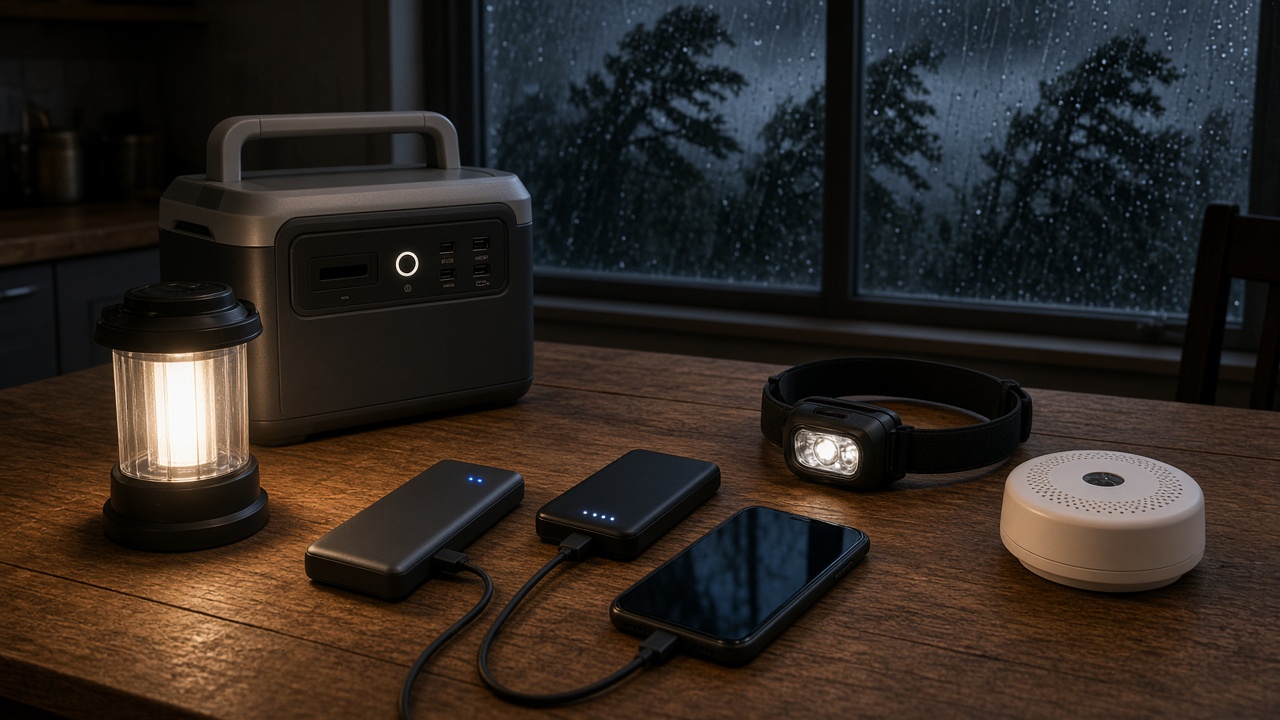
This is the cheapest item on the list and the only one that can save your life. CO has no smell or colour. If you have a gas boiler, gas fire, wood burner or you might run a camping heater or generator during an outage, you need one.
What to look for:
- Kitemark / EN 50291 certification printed on the box.
- Sealed long-life battery (often sold as 7 or 10-year), so it still works when the mains is off.
- An end-of-life warning, because CO sensors expire. Check the date on your existing alarm; many people find theirs is years past it.
Browse CO alarms at Screwfix · Browse CO alarms at Argos
Never use a barbecue, camping stove or petrol generator indoors or in a garage during a power cut.
2. Power banks: keep phones alive
When the power goes, your phone becomes your torch, radio, outage map and way to call for help. A decent power bank is the easiest win.
What to look for:
- Capacity: around 20,000mAh will typically recharge a modern phone several times. 10,000mAh fits a pocket.
- USB-C Power Delivery for fast charging and the ability to top up a tablet or small laptop.
- Pass-through charging is handy so the bank and phone charge together when power returns.
Tip: charge them now, when a warning is issued, not when the lights are already off. Lithium banks slowly lose charge in a drawer, so top them up monthly through winter.
Browse power banks at Argos · Browse power banks on Amazon UK
3. Portable power stations: the big upgrade
A portable power station is essentially a large rechargeable battery with mains sockets (AC), USB ports and often a 12V car socket. Unlike a petrol generator, it is silent, produces no fumes and is safe to run indoors.
Who it’s for: households in rural areas that lose power regularly, home workers who can’t afford a day offline, anyone with medical devices that need power, and people who camp in summer anyway.
What to look for:
- Capacity in watt-hours (Wh): this is the fuel tank. Divide it by a device’s wattage for a rough runtime. A 10W router on a 500Wh unit would, in theory, run for many hours; a 2kW kettle would flatten it fast.
- Output in watts: must exceed what you plug in. Kettles and heaters are usually out of reach for smaller units.
- LiFePO4 battery chemistry: longer lifespan and generally considered more stable.
- Solar input, if you want to recharge during a multi-day outage.
Be realistic: a power station keeps the lights, phones, router, a laptop and maybe a fridge going. It won’t run your central heating or an electric oven.
Browse portable power stations at Currys · Amazon UK
4. Head torches: hands free, no candles
Candles are a fire risk, especially with kids or pets about. A head torch leaves both hands free for finding the fuse box, cooking on a camping stove outside, or getting the kids to bed.
What to look for:
- USB-C rechargeable, so you can top it up from that power bank.
- A red-light mode, which is less dazzling for others in the room.
- Water resistance (IPX4 or above) if you might need to check outside.
Grab one per person and keep them in the same drawer as your power banks. Battery LED lanterns are a great addition for lighting a whole room.
Browse head torches at Decathlon · Argos
The 10-minute storm checklist
When a yellow or amber warning is issued:
- Charge every power bank, phone and power station.
- Test your CO and smoke alarms.
- Put head torches and lanterns somewhere you can find in the dark.
- Save 105, the free UK power cut number, in your phone.
- Bring in or tie down bins, trampolines and garden furniture.
- Keep the freezer shut during an outage; a full freezer stays cold for longer.
The verdict
If you buy one thing, buy a CO alarm with a sealed long-life battery. If you buy two, add a 20,000mAh power bank. A portable power station is the big-ticket upgrade that genuinely changes how a power cut feels, but only if you lose power often or work from home. With more storms forecast, now is the time, not when the shelves are empty.