Beat the Damp for Less: Dehumidifiers and Heated Airers, and What They Cost to Run per Hour
Contains affiliate links.
The trend
Condensation on the windows, black spots in the corner of the bathroom, washing that takes three days to dry on the radiator. Britain has hit damp season, and the searches show it.
In Look Into’s UK Demand Index for the week to 15 October 2026:
- Dehumidifier: up 25.6% week on week
- Heated airer: up 22.3% week on week
Look Into also tracks what it calls “the damp turn”: the week UK searches stop being about moving air (fans) and start being about removing water. In 2026 it landed in the week of 16 August, and dehumidifiers have stayed ahead of fans for eight weeks running since. With Storm Austen and Storm Boelo dumping heavy rain this week, that’s unlikely to change.
The price you’re paying for electricity
Both gadgets run on electricity. From 1 October to 31 December 2026, Ofgem’s capped average unit rate is 26.32p per kWh for Direct Debit customers, with VAT removed from electricity bills until 31 March 2027 (Ofgem). Your rate may differ by region and tariff.
Cost per hour = watts ÷ 1,000 × 26.32p
Dehumidifiers: two types, very different running costs
Compressor dehumidifiers
These work like a small fridge: air passes over a cold coil, moisture condenses and drips into a tank. They’re the most efficient choice in a normally heated home, and their wattage is usually modest. Many sit roughly in the 150–300W range; check the label.
- At 200W: about 5.3p per hour
- At 300W: about 7.9p per hour
Downsides: they lose efficiency in cold rooms (an unheated garage or conservatory) and can be noisier.
Desiccant dehumidifiers
These use an absorbent wheel and a heater to drive the moisture out. They work better in cold spaces and are often quieter, and they give off noticeable warmth, which some people like in winter. But they tend to draw more power, often in the 500–700W range.
- At 600W: about 15.8p per hour
Rule of thumb: heated living space → compressor. Cold garage, boat, caravan or unheated room → desiccant.
What to look for
- Extraction rate in litres per day, quoted at specific test conditions. A 10–12L model suits a flat; bigger or damper homes may want 20L.
- Humidistat: set a target (around 50–60% relative humidity) and the unit switches itself off when it gets there, which cuts running costs a lot.
- Laundry mode: a high-fan setting for drying clothes.
- Continuous drain hose option so you’re not emptying the tank every few hours.
- Tank size and auto shut-off when full.
Browse dehumidifiers at Argos · Currys · Amazon UK
Heated airers: cheaper drying than the tumble dryer
A heated airer is a clothes horse with gently warmed bars. They’re popular because, like the electric blanket, they use a small amount of power for a focused job. Many are rated roughly 100–300W.
- At 150W: about 3.9p per hour
- At 300W: about 7.9p per hour
A typical heated airer might run for several hours to dry a load, so a full session could still come to well under a pound, depending on wattage and load. That’s the appeal compared with a tumble dryer, which typically draws far more power per hour (check your own model’s rating).
The catch: a heated airer puts moisture into the room as the clothes dry. On its own in a closed room, it can make condensation worse. The fix is to dry near an open trickle vent or extractor, or better, pair it with a dehumidifier.
What to look for
- Wattage printed clearly, so you can cost it.
- Number of tiers and total hanging length: winged and three-tier designs fit far more.
- A cover: some come with one that traps heat like a mini drying cabinet and can speed things up.
- Timer and fold-flat storage.
Browse heated airers at Argos · Lakeland · Dunelm
The combo that works
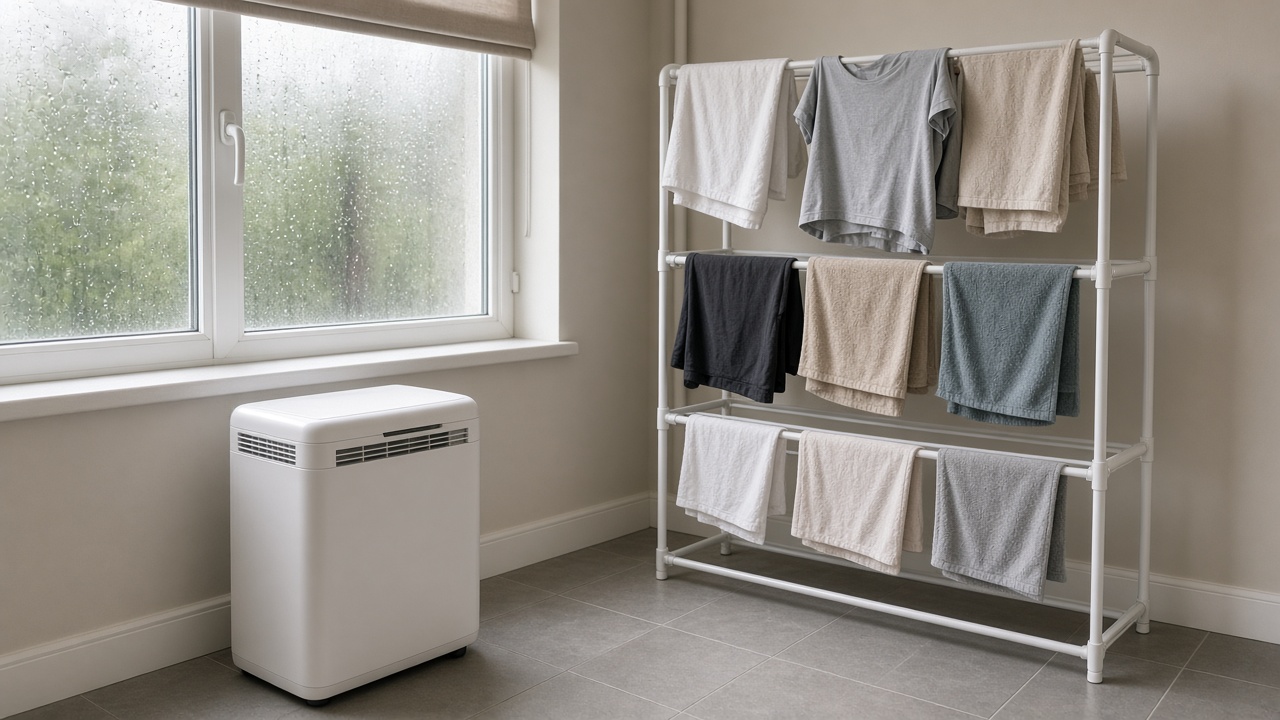
Dry your washing on a heated airer in a small room with the door shut and a compressor dehumidifier on laundry mode. The airer warms the clothes, the dehumidifier pulls the water out of the air, and you avoid both the tumble dryer and the mould. Using the illustrative wattages above, running both together would cost roughly 9–16p per hour at the current cap.
Free fixes first
Before spending anything:
- Open windows for 10–15 minutes in the morning to clear condensation.
- Use extractor fans while cooking and showering, and keep lids on pans.
- Wipe condensation off windows daily. A window vacuum makes this quick.
- Keep furniture a few centimetres off external walls.
- Keep rooms consistently, gently heated rather than freezing then blasting.
If you rent and have serious damp or mould, report it to your landlord in writing. It may be their responsibility to fix.
The verdict
For most heated UK homes, a compressor dehumidifier with a humidistat is the best-value damp fighter, costing pennies per hour. A heated airer is the cheapest way to get washing dry indoors, but only pair it with ventilation or a dehumidifier. Buy before the next storm-soaked week, not after the mould shows up.

2 Comments