Are You in the Wrong Council Tax Band? How to Check in 5 Minutes and Challenge It
Council tax is one of the biggest bills most households pay, and the band your home sits in decides how much. Bands were set decades ago, and some homes ended up in the wrong one. Checking takes five minutes on GOV.UK and costs nothing. Here’s how to do it properly, and the risk you need to know about before you challenge.
How bands work, quickly
In England and Scotland, council tax bands are based on what your home would have been worth on 1 April 1991. In Wales, they’re based on values at 1 April 2003. Bands are set by the Valuation Office Agency (VOA) in England and Wales, and by local assessors in Scotland. Your council then sets the amount each band pays (GOV.UK: how council tax bands are assessed; for Scotland, see the Scottish Assessors).
That’s why two identical houses on the same street should normally be in the same band. And it’s why comparing yourself with your neighbours is the best first check.
Step 1: Look up your band and your neighbours’
Use the official, free service: Check your Council Tax band on GOV.UK (England and Wales). In Scotland, use the Scottish Assessors’ website.
Enter your postcode and you’ll see the band for every home on your street.
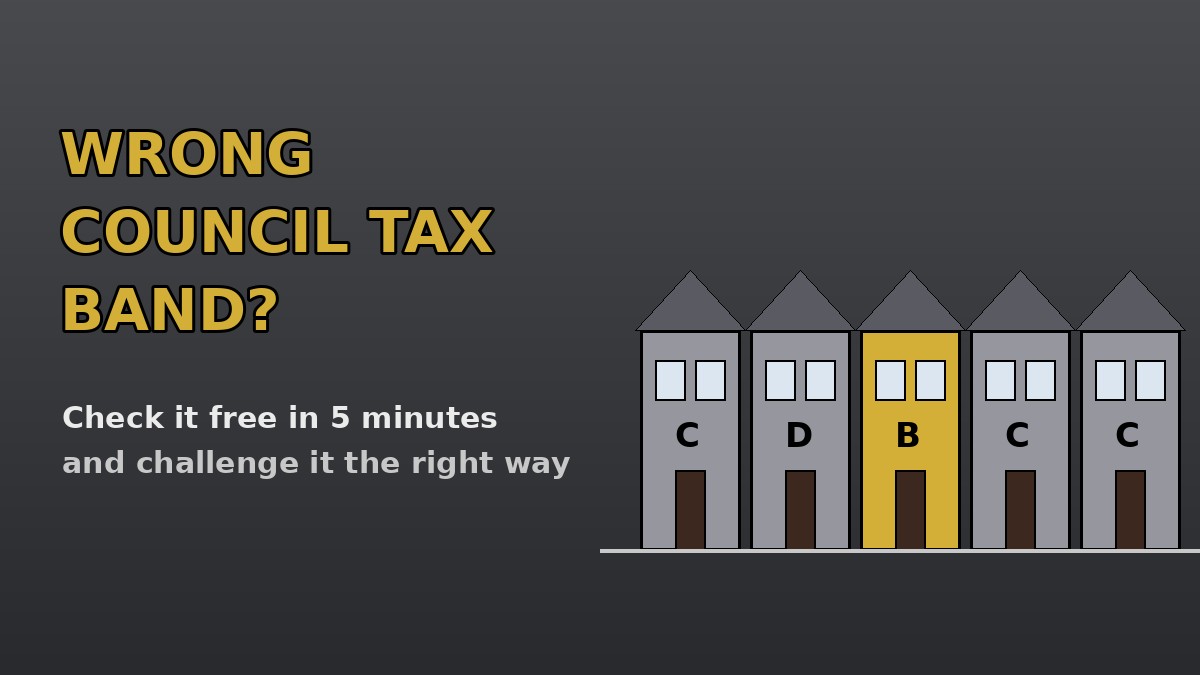
What you’re looking for: homes that are similar to yours (same type, size and age, ideally built at the same time) but in a lower band.
Step 2: Gather evidence
The VOA has published guidance on what makes a strong challenge (VOA blog). Comparable properties are the key evidence. Make a note of:
- The addresses of similar homes in lower bands, usually up to five (GOV.UK step-by-step guide).
- Why they’re comparable: same layout, number of bedrooms, floor area or build date.
- Any differences that matter, such as an extension, which could explain a higher band.
Old sale prices can help too. Listing and sold-price history on property sites can show what similar homes were worth, though the VOA works from 1991 (or 2003) values, not today’s.
Step 3: Challenge it the right way
GOV.UK sets out two routes (GOV.UK step-by-step guide):
An informal review
If you’ve paid council tax on the property for more than six months, you can ask the VOA to review your band, giving your evidence. The VOA may review it, but it isn’t legally required to.
A formal proposal
In certain situations, for example within six months of becoming the taxpayer at a property, you can make a formal proposal, and the VOA must review it. The GOV.UK guide explains who qualifies.
Either way, it’s free. You do it directly with the VOA online. You don’t need a company that charges a fee or takes a cut of your refund.
Keep paying your current bill while your challenge is considered.
If you win
If your band is lowered, the VOA sets the date the change takes effect, and your council refunds or credits what you overpaid. Refunds can be backdated. How far back depends on when the VOA says the change takes effect and how long you’ve been liable at the property, so ask your council once the decision comes through.
The risk: your band can go UP
This is the bit too many “check your band!” articles leave out. When the VOA reviews a band, it looks at the property properly, and bands can go up as well as down. If your home is actually under-banded, your bill could rise. A higher band can also affect your neighbours if the VOA reviews similar homes.
So before you challenge, ask yourself honestly:
- Is my home really the same as the cheaper ones?
- Have I (or a previous owner) extended it or added rooms? Lofts and extensions often explain a higher band.
If you’re confident, go ahead. If you’re not sure, the five-minute check costs nothing, but the formal challenge is a judgement call.
Other council tax savings people miss
Even if your band is right, you might be paying more than you need to:
- Single person discount: 25% off if you’re the only adult in the home (GOV.UK).
- Council Tax Reduction: help for people on a low income. Apply through your council.
- Disabled Band Reduction Scheme: if your home has been adapted for a disabled person.
- Certain people are “disregarded”, such as full-time students and some carers, so they don’t count when working out discounts.
Details are on GOV.UK’s council tax pages and your council’s own website.
Looking for more ways to cut household bills? See our guide to the cheapest way to dry clothes indoors and how to claim Delay Repay compensation for late trains.
Told straight
This isn’t a guaranteed refund. Plenty of people check and find their band is spot on. But it’s free, it takes five minutes, and if your home really is in the wrong band, the savings come every single year, and maybe a backdated refund too. Just compare like with like, know the band can go up, and never pay someone to do it for you.
Process checked against GOV.UK and VOA guidance in October 2026. Council tax rules differ between England, Wales and Scotland. Northern Ireland uses domestic rates instead.